208.4.1 Distributed Concurrent Processing
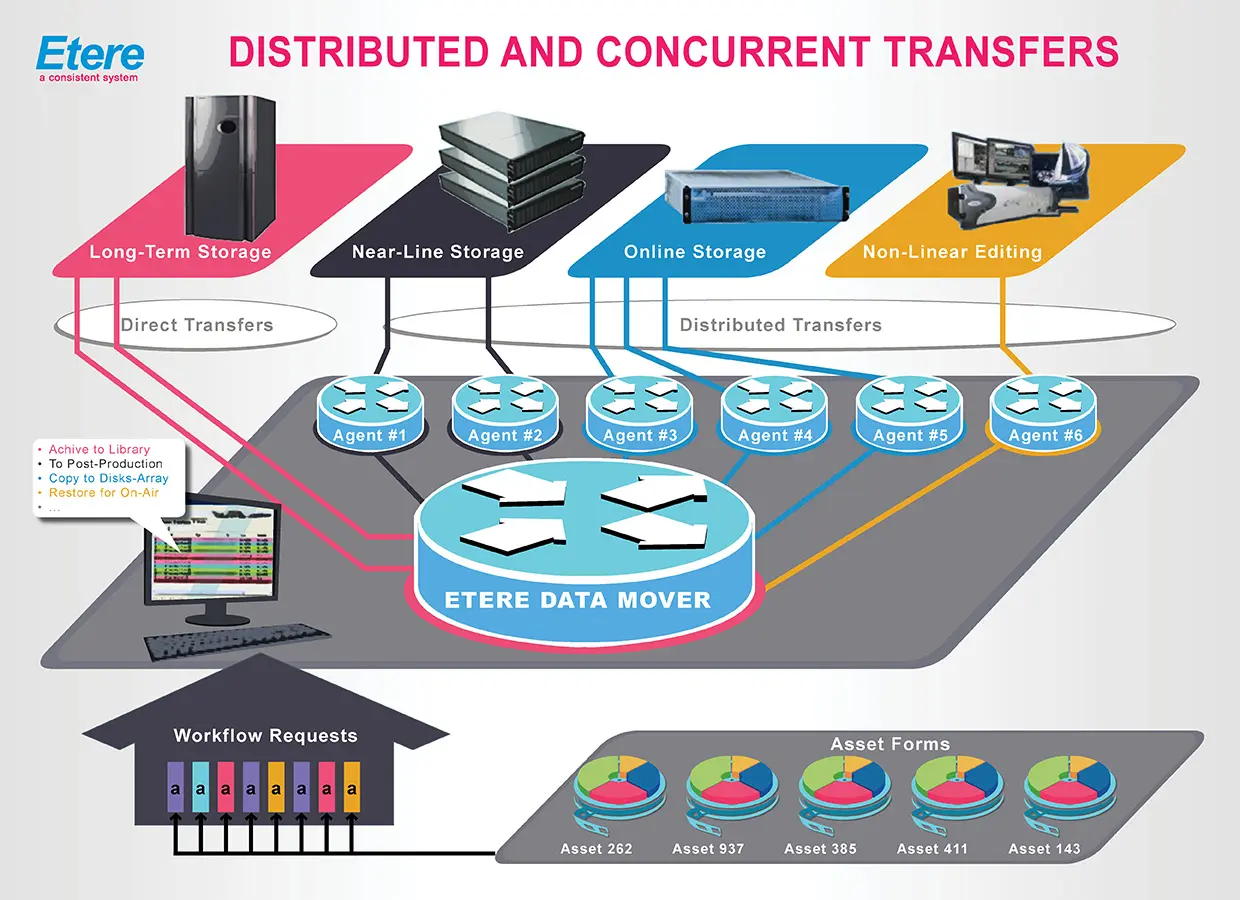
Etere Data Mover is capable to provide distributed processing for using an independent agent per data transfer and concurrent processing for simultaneously performing different instances of one data transfer; these features will allow stations to exploit high computing resources using single workstation to perform multiple transfers, thus enhancing the flexibility, scalability and fault-tolerance of the entire Etere system.
The Etere's distributed concurrent approach is based on a 'divide and conquer' strategy in which Etere Data Mover delegates tasks to separate agents which work in concurrency, this implementation has been synthesized in the following sequential diagram:
Distributed Concurrent Processing
As show in the figure above, each time Etere Data Mover receives a T-workflow request for a data transfer, it checks if the requested action has the following features enabled:
•If the data transfer allows concurrency, it would be performed concurrently with an existing instances; else Etere DataMover will wait for a instance of the data transfer to complete before processing. Please consult the DataMover Concurrency chapter for further details.
•If a data transfer allows using agents, a separate agent would perform the action; otherwise the data transfer would be performed by the Etere DataMover. Refer to the DataMover Agents chapter for detailed information.
Difference between concurrency and parallelism
Concurrency means running different tasks (not necessarily at the same time) simultaneously in overlapping within time periods; instead, parallelism occurs when these simultaneous tasks are run exactly at the same time. It's worth mentioning that in cases the switching between processes is quick enough, concurrency can appears as parallelism.
 Distributed_Concurrent_Processing