70.1.3 Linear Tape File System (LTFS)
The Linear Tape File System format (LTFS) is unique from others file format, with this format, data is stored in LTFS Volumes. An LTFS Volume holds data files and corresponding metadata completely describe the directory and file structures stored in the volume.
The LTFS consists of three specified characteristics:
-An LTFS Volume can be mounted and volume content accessed with full use of the data without the need to access other information sources.
-Data can be passed between sites and applications using only the information written to an LTFS Volume.
-Files can be written to, and read from an LTFS Volume using standard POSIX file operations.
LTFS format is particularly suitable for following operation environments:
-Data export and import.
-Data interchange and data exchange.
-Direct file and partial file recall from sequential access media.
-Archival storage of files using a simplified, self-contained format on sequential access media.
Consistency Check
When processing LTFS file format, HSM Data Pump would perform a consistency check on data format before writing to database. The consistency check results would be written into log file for assessment. The consistency check includes:
•File system on tape
•Data operation time on tape
•The congruent in file size
One possible error resulted from the consistency check would be:
Consistency check! Archive was not performed: file L:\1001.mxf not found
When processing tapes with Etere Exchange Format (EXF) or Archive Exchange Format (AXF) on HSM Data Pump, the LTFS file system is compatible for read operation only.
LTFS Volume Layout
LTFS Volume comprised strictly a pair of LTFS partitions, which is data partition and index partition.
Each LTFS partition in LTFS Volume consist of Label Construct, Data Content Area, and Index Construct:
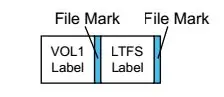
Label Construct
Content Area
-Label Construct: contains identification information of the LTFS volume.
The Label Construct consists of an ANSI Vol1 label , followed by a file mark, followed by one record in LTFS label format, and followed by a single file mark. Each Label Construct for an LTFS volume must contain identical information except for location field of the LTFS label.
File Mark 1
-Content Area: it consists of Data Extents and Index Construct.
➢Data Extent: A Data Extent is a set of one or more sequential logical blocks used to store file data. The “block size” field of the LTFS Label defines the block size used in Data Extents. All records within a Data Extent must have this fixed block size except the last block, which may be smaller.
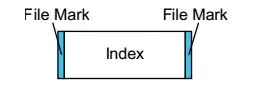
➢Index Construct: contains index, which is an XML data structure that describes the mapping between files and Data Extents.
The figure below shows the structure of an Index Construct. An Index Construct consists of a file mark, followed by an Index, followed by a file mark. An Index consists of a record that follows the same rules as a Data Extent, but it does not contain file data.
File Mark 2
LTFS Partition Layout
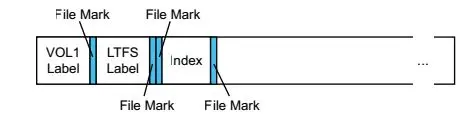
As mentioned, An LTFS Partition contains a Label Construct followed by a Content Area. The Content Area contains zero or more Data Extents and Index Constructs in any order. The last construct in the Content Area of a complete partition must be an Index Construct. The figure below illustrates an empty complete partition. It contains a Label Construct followed by an Index Construct.
File Mark 3
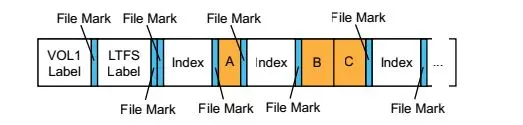
The figure below illustrates a complete partition containing data. The Content Area on the illustrated partition contains two Data Extents (the first extent comprising the block ‘A’, the second extent comprising blocks ‘B’ and ‘C’) and three Index Constructs.
File Mark 4
Support LTO 8 Tape
Etere HSM is compatible with Linear Tape-Open 8 (LTO 8) technology, with a 20% increase in performance over LTO 7.
LTO 8 offer an uncompressed storage capacity of 12TB and compressed capacity of up to 30TB using a 2.5:1 ratio, with compressed data transfer rate at 750MB per second, and uncompressed rate of 360MB per second. LTO 8 tape drive support backward compatible with LTO 7 tape media, it also support Linear Tape File System (LTFS), WORM (Write once read many) and AES 256-bit hardware encryption. Etere HSM allows users to mix different file systems and archival technologies, providing flexibility and options for customer to manage their media library.
For LTO tape to function properly, the media format of LTO tape must be defined as “Type = Data Tape” in Etere Configuration module.
NB: From Etere released version 29.3 onwards, HSM support LTO 8 (12TB) and LTO9 (24TB) media formats. Upon configure the tape drive, you must execute “System Maintenance > Check Main database structure” task and includes (put a tick on it) scripts “ZZ_FINALIZATION” and “Default values” (listed at the bottom of the System Maintenance script list) to recognize the new media formats.
 File_Mark_1
 File_Mark_2
 File_Mark_3
 File_Mark_4