59.6.2.168 Imagine - Imagine Logo resource editor
Etere can control Imagine Logo devices (e.g. IconStation and Inscriber G5), whether via serial or ethernet, through a protocol based on the standard protocol CII (the device receives CII commands to trigger layouts to air).
The "Edit Resource" form allows one to define an Imagine Logo Generator resource. The fields required for its configuration are following described:
READ-ONLY INFO
Code - The path of the resource that you are editing is displayed.
Type - Shows the type the resource belongs to (e.g. LOGO).
Number - Ordinal number that differentiates the resource from others of the same type.
RESOURCE PROPERTIES
Name - A brief description identifying the resource must be inserted (e.g. IconMaster Logo).
Driver - Select the driver to be used by Etere to control the logo generator. Available drivers include:
ICONMASTERL
Use this driver to communicate with the IconStation device via serial (COM). In this case, managing four layers (which will be automatically created in the resources tree) will be possible.
ICONSTATION
Use this driver to communicate with the IconStation device via ethernet (IP); no layers will be created in this case. It will be required to indicate:
•IP Address: show the IP address of the Logo
•Local Port: show the local port of the Logo (default=9100)
INSCRIBERG5
Use this driver to communicate with the Inscriber G5 device via serial (COM).
•Templates path in the device: Indicate the UNC path to the device's folder containing all the project templates.
•Unit ID: Optionally, set it if a specific device must be controlled in a pool of devices.
•Destination: Optionally, set it if more than one channel is to be controlled.
NB: A project must be created within the server to be controlled (which directory is set in the driver's MsgDir parameter), which contains all the graphics to be used (numbered from 1 to 999).
INSCRIBER G5IP
Use this driver to communicate with the Inscriber G5 device via ethernet (IP). It will be required to indicate:
•IP Address: show the IP address of the Logo
•Local Port: show the local port of the Logo (default=9100)
E19 Resource ID - Optionally, insert the ID of the resource created under the Resource Editor module for this resource. This identification number is used, for example, to check the storage space usage of the resource.
Whichever the selected driver is, it will be possible to set the following Configurations:
RESOURCE PARAMETERS
Logo configured as - Set the logo configuration (i.e. crawl, logo1, logo2, etc). By default, nothing is selected.
Linked DSK - Specify if the DSK is either internal or related (to a Master Control):
Inside - This option indicates that the DSK is internal (i.e., within the Logo Generator).
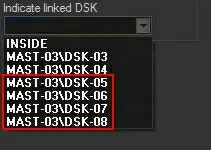
DSK "n" - Select an existing DSK to indicate that the layer is linked. In case the Logo is related to an IconMaster MC, each Logo Layer must be connected as follows:
Indicate_linked_DSK
Logo's Layer 1 --> MC's 3rd DSK (e.g. DSK-05)
Logo's Layer 2 --> MC's 4th DSK (e.g. DSK-06)
Logo's Layer 3 --> MC's 5th DSK (e.g. DSK-07)
Logo's Layer 4 --> MC's 6th DSK (e.g. DSK-08)
Please note that the 1st and 2nd DSK of the Master Control are not linked.
NB: Only DSK resources configured and assigned to automation will be displayed here.
Preset/Take mode - Enable the preset/take mode to pre-load logos before sending them on-air, speeding up the take operation.
NB: Preset/take mode is advisable only if a switch is used for all events. Otherwise, results could be unpredictable.
Once compiled, click on the [Confirm] button to add the LOGO resource to the Resources tree (it will be created featuring eight different layers). Afterwards, it will be possible to configure the following:
· Device users: Select the resource and click the [Users] button.
Imagine Logo resource editor - User.
Indicate to which user and to which module or program the relevant resource must be activated by specifying the following:
READ-ONLY INFO
Resource - Code of the resource layer.
Name - Name of the resource layer.
ID Number - Identification number of the resource layer.
USER INFORMATION
PC Name - Indicate the specific workstation (user) for which the resource will be allowed. Once selected, it will be automatically retrieved and displayed the ID number and PC name corresponding to the selected user.
Function - Indicate the module (function) on which the above-mentioned user will be allowed to use the resource.
 Indicate_linked_DSK