93.2.1.12 MMS - Partial Retrieve
MMS - ETERE PARTIAL RETRIEVE is the action used by ETERE system to create a new file from an existing one, according to the marks specified in the source asset's EDL.
MMS---Partial-Retrieve---General-Tab
MMS---Partial-Retrieve---Partial-Retrieve-Tab
To create this action, the following fields must be filled.
GENERAL TAB
Name: Give it a short name to identify the action.
Operation: Select "Etere Partial Retrieve" option.
SOURCE
Current metafile: Select this option to use the current metafile previously set.
Device/Codec: Select the source device and codec. If the metadevice contains multiple versions (codecs) of the file, select the codec you wish to copy or delete.
DESTINATION
Device: Select the destination device to which the files would be copied.
Path: If the selected cloud device contains more than one path, this parameter allows one to choose one of them as the destination path. It's also possible to choose the selection mode for the destination path:
• Fill Then Next - If enabled, MMS starts with the first path and checks whether that path has enough space; if it has enough space, MMS uses it. Otherwise, MMS checks again until the following available path is found.
• Random - If enabled, a random path is chosen among the available ones.
• Round Robin - If enabled, the path is chosen from the first to the last of the available ones and then starts again at the top of the list, and MMS continues to search in this sequence. The selection status is shared globally among all MMS instances that work on the configured cloud device. If a service selects the 1st path, another one on a second machine or another instance of the same action in the same MMS will choose the 2nd one.
Codec: Select the destination codec where the files would be copied to.
OPTIONS
Do not use media folders even if configured: Enable this option to ignore the translated path, even if it's configured.
Concurrent processes: Indicate the maximum number of actions that can be taken at the workstation simultaneously.
Never update DB files: The file won't be updated in the database.
Update all assets linked to the source file: If enabled (default), the copied file will be associated with all the asset forms linked to the source file.
Enabling this option is useful, for instance, when a single file is used by multiple assets (e.g. which transmit it overlaid with different logos); in this case, every time the file is copied, the new copy will be updated across all linked assets.
If disabled, the copied file will be associated only with the asset form for which the T-workflow has been launched.
Disabling this option is useful, for instance, when a single big file (e.g. a live feed recording) is used by multiple assets which partially retrieve a smaller file; in this case, only the support from which the partial retrieve has been executed will be updated.
Use SSL: Enable this option to use SSL (Secure Socket Layer) when saving the file in a destination path over the network. If enabled, the service media manager would attempt to complete the action using the following authentication steps in sequential order:
- FTP over TLS (Transport Layer Security)
- FTP over SSL (Secure Socket Layer)
- Plain FTP (without encryption)
If the FTP server supports SSL encryption, the Media Manager service will use a new set of libraries for copying files. Else, Plain FTP would be used.
Use passive mode: If checked, the FTP client will try to use passive mode for all file transfers (upload/download/move); otherwise (if disabled), the standard active way will be used.
Use "passive server to server" when moving between FTP servers: Enable this option if both source and destination devices use the FTP protocol and support 'passive mode'.
Check the file size with db value: If enabled, an additional check would be performed to compare the size of the copied physical file and the file size stored on db. This is useful to signal if the file has not been copied entirely into the destination folder. In this case, its file size differs from the original one, and this check can alert the operator by signalling an error in the wf. Not available for this kind of action.
Skip media check: Allow to avoid checking if the source file's device and codec match with the ones defined in the action. This is mandatory in the case of the Memory cut action because the Memory cut wf is attached to a new empty asset with no meta file, so the action would end in error if this parameter is disabled. Not available for this kind of action.
Maximum Bandwidth: The maximum bandwidth option is only supported for copies to limit the bandwidth used for data transfers.
PARTIAL RETRIEVE TAB
Process: Choose which process should transcode the file: Etere transcoding or a different application.
Profile: If the Etere transcoder is selected, it is possible to choose the transcoding profile to use or create a new one.
Command: In case an external application is selected, the .exe that will perform the transcoding must be specified. In the command line, some attributes can be added using the following variables, displayed in the legend below this field:
%1:s - Media name as requested
%2:s - Media name without extension
%3:s - T-Workflow job ID
%4:s - Log filename (including full pathname)
Asset created with the same content - Type: Choose if the new asset type should be the same as the source segment, the same as the source asset, a user-defined type or the system type PRT.
Associate t-workflow: If the system should start a wf upon completion of the partial retrieve, select it here.
Note: to use the MMS_PR action you need the ET0092 license.
 MMS---Partial-Retrieve---General-Tab
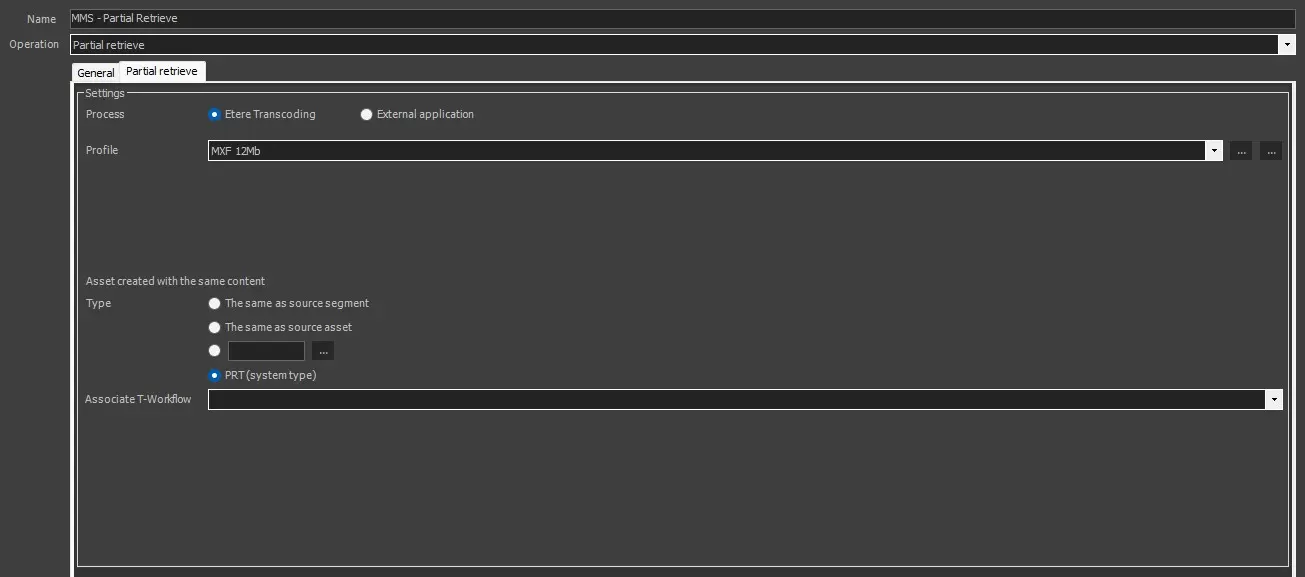 MMS---Partial-Retrieve---Partial-Retrieve-Tab