67.3 Adding a Network Stream Input
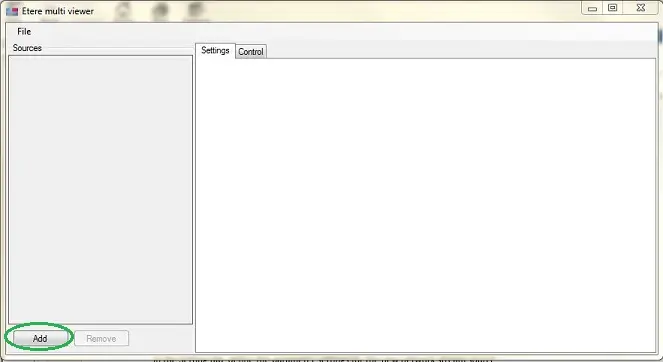
In the <Settings> tab, you can insert input source to Multiviewer by clicking on the <Add> button at the bottom panel.
4738_Etere_Multi_viewer_1
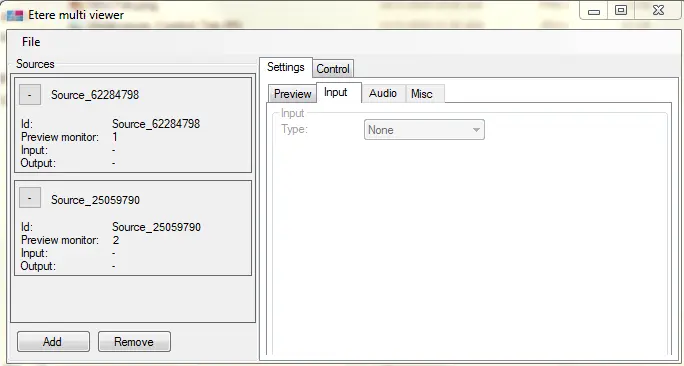
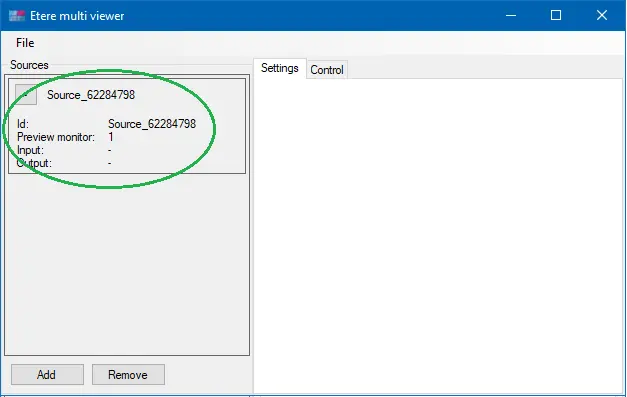
A new input source is inserted into Multiviewer and pending configuration.
Etere Multi viewer 2
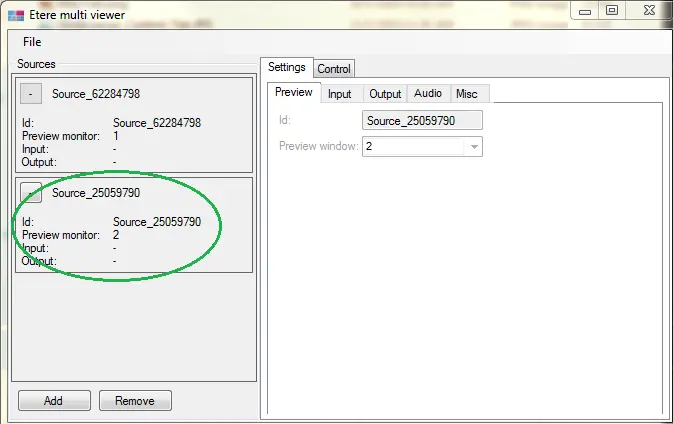
Now, double-click on the new input source and configure its various settings.
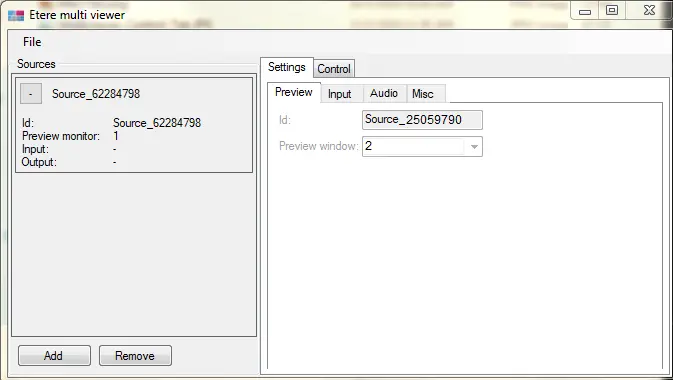
Preview settings
Etere Multi viewer 3
•ID: A source ID would be auto-assigned to the new input source. You can edit the ID to suit your requirements.
Input settings
Etere Multi viewer 4
•Type: Select an input type to identify the input source, e.g., Network Stream or NDI Stream.
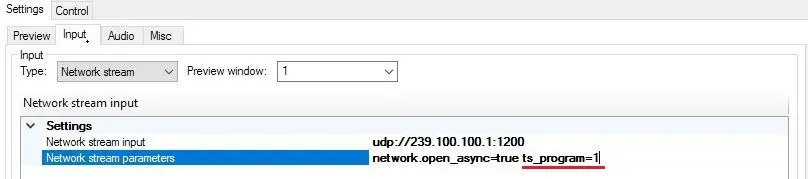
Note that the transport stream is 0 (zero) based; if the input network stream contains one program stream, it will start from the first (0). If the network stream contains multiple programs, you can start from any program stream using the “ts_program” parameter from the Network Stream parameters settings.
Multiviewer_network_stream_parameter
In the above example, the “ts_program” is set to “1” to start from the second program in the network stream.
•Preview Window: Select one of the preview windows (total of 24 windows) in Multiviewer to view the input source.
NB: By setting the Preview window display to "0" (zero), you can stream an NDI input source to a UDP output stream in Automation without the preview window displayed in Multiviewer.
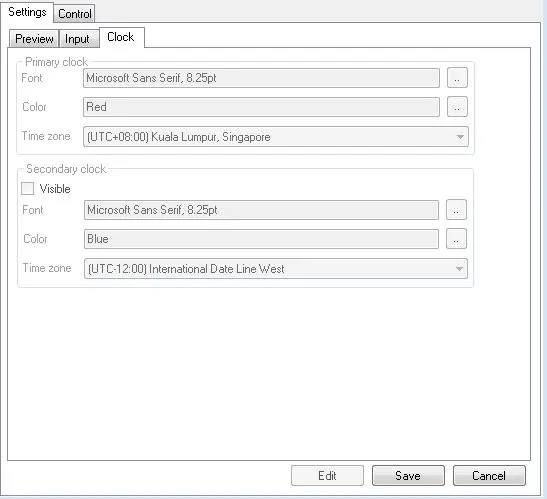
In the Type field, if you select the “Clock” option from the list, a “Clock” tab will be added to the display.
Multiviewer_input_clock
Where you can set the display style of the primary and secondary clocks:
•Select the font style and size,
•Set the colour of the display.
•Select a specific time zone to be displayed.
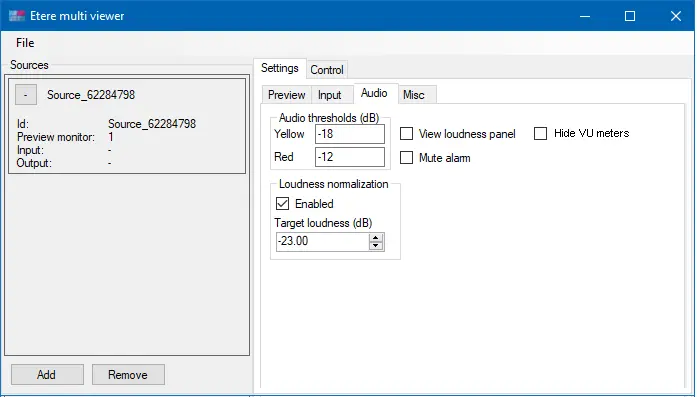
Audio settings
Multiviewer_settings_audio
- Audio Threshold (dB)
Specify the Audio Threshold (dB). The loudness of audio is measured in decibels (dB) to express the relative intensity of sounds on a scale from zero (0).
•Yellow: Set the threshold value for measuring the loudness indicated in yellow (see details below)
•Red: Set the threshold value for measuring the loudness indicated in red (see details below)
(Yellow and red refer to VU meters. The audio level on the VU meter is shown in green if it is under the yellow value and shown in “green + yellow” if it is under the red value. When it exceeds the red value, it is shown in “green + yellow + red”.)
View loudness panel: Enable this option to view the loudness unit in the preview panel.
Mute alarm: Enable this option to silence the alarm.
Hide VU meters: Enable this option to hide the audio VU meter in the Preview window.
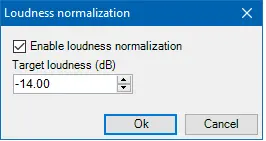
- Loudness normalisation:
Loudness normalisation
Turn the loudness normalisation feature on/off.
•Target loudness (dB): If loudness normalisation is enabled, set a loudness unit to normalise the loudness to a target level. For example, when the reference normalise level is set at -14.00 LUFS, if a program is analysed to be -10.00 LUFS, the level would be lower by 4 dB to match the target loudness of -14.00 LUFS.
NB: The new loudness unit would take effect immediately without restarting the Multiviewer.
➢Loudness normalisation for Live source
It is not possible to pre-read the audio data in a Live source. Hence, previously used normalisation data would be read to manage the loudness. By default, it used RMS (Root Mean Square) data to determine the loudness. RMS metering is designed to give a better impression of perceived loudness by calculating the average loudness level over a short period. There could be audio peaks if the gain is changed significantly on the source.
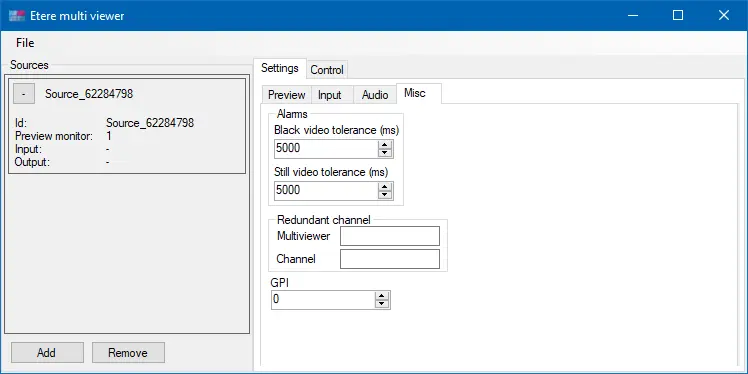
Misc settings
Multiviewer_settings_misc
- Alarm
•Black video tolerance (ms): Set the threshold (in milliseconds) to trigger a sound alarm when a black screen occurs in the video file exceeds the threshold.
•Still video tolerance (ms): Set the threshold (in milliseconds) to trigger a sound alarm when a still image occurring in the video file exceeds the threshold. You can turn off the still image alarm by setting the value to “0”.
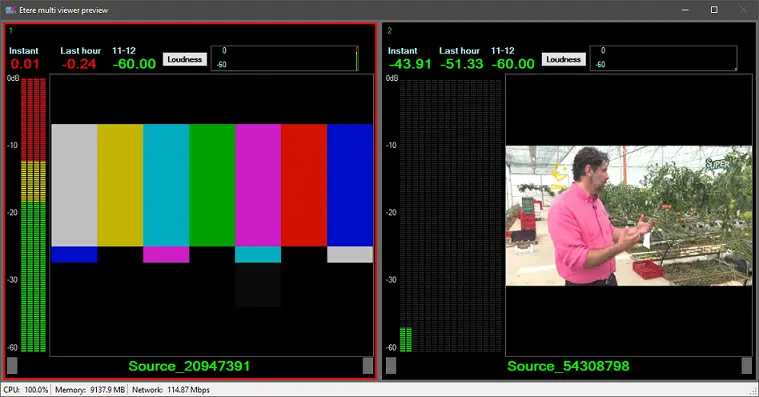
When an alarm is triggered in any preview, the border of the preview window will be outlined in red, as indicated below.
Multiviewer_settings_misc_alarm
- Redundant Channel
•Multiviewer: Specify the preview monitor ID in Multiviewer.
•Channel: Specify the redundant channel number.
•GPI: When a GPI device is used, specify the GPI number used for input.
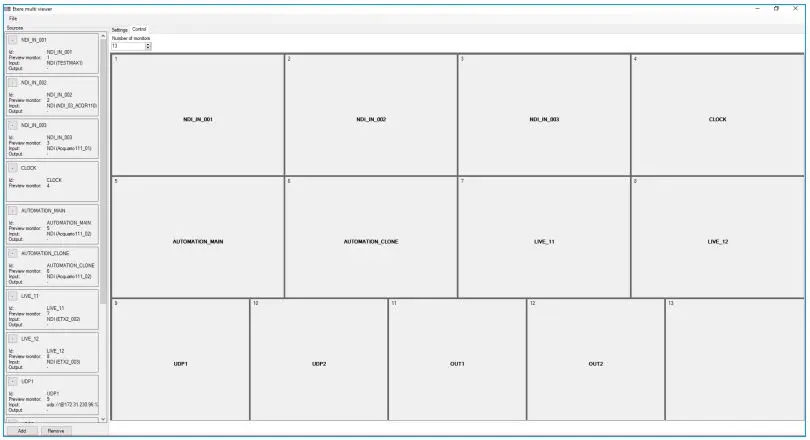
Once configured, the input would be updated in the <Control> tab as indicated below.
Multiviewer_control_preview
You can repeat the steps described above to add multiple network stream inputs to Multiviewer by specifying a different Preview ID and different Preview window.
Configure NDI Stream
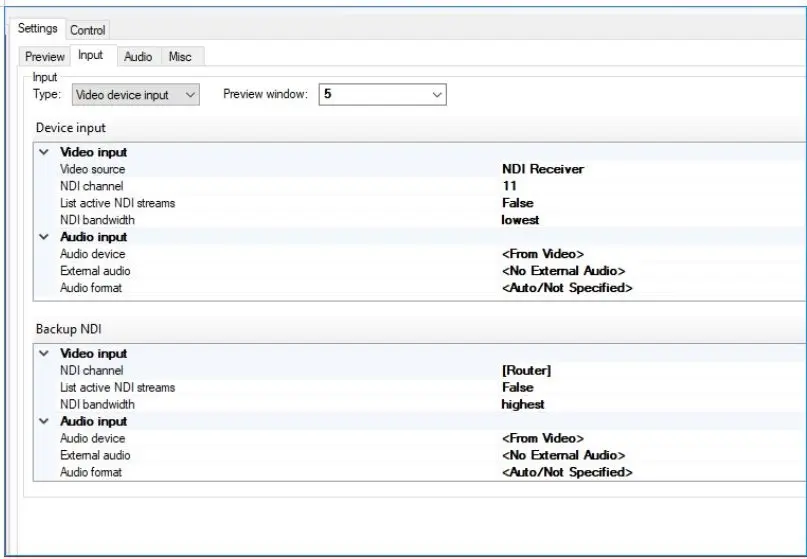
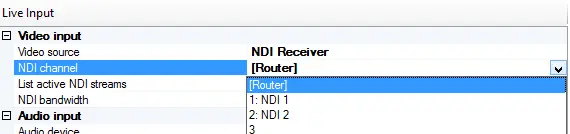
In ETX-M Multiviewer, you can choose an NDI Router as the network input stream by selecting an NDI Receiver as the input source.
The NDI channel properties display a list of channel names and their related descriptions for selection.
Live input
If the network stream input source is an NDI stream, all the Audio Input parameters would be automatically compiled to the default values.
If there are missing configurations in the Audio Input section, when the user selects the Video device in Video Input, the missing configuration in Audio Input and all parameters in Video Input will be set to the first available value in the list.
Multiviewer_preview_add_ndi_input
NB: From Etere released version 30.2 onwards, despite the “List active NDI stream” being set to “True”, only the name of the active NDI stream would be shown, and the IP address and port number of the NDI stream would be invisible.
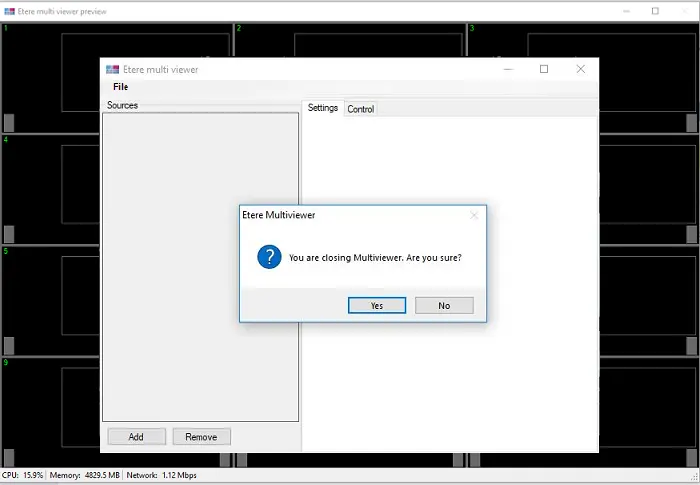
If you have configured multiple NDI input streams, all input streams are displayed with mainly 3 general statuses:
Etere Multi viewer preview 2
•NDI stream from the main source, e.g. “NDI IN LIVE A”
•NDI stream from the backup source, e.g. “NDI IN LIVE B (Backup)”
•No NDI signal detected, e.g. “NDI Receiver – No video signal”
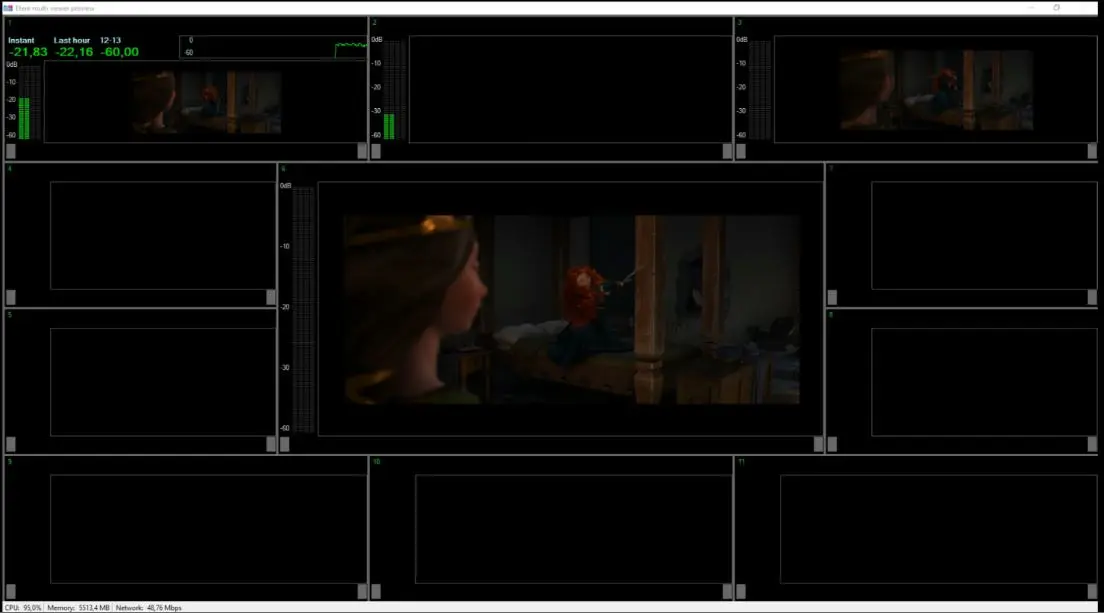
NDI Stream to all preview windows in the Multiviewer monitor
By configuring a network stream with an NDI router in Multiviewer, Multiviewer can generate all video content to all the preview windows in Multiviewer Monitor.
Etere Multi viewer preview 3
 Multiviewer_input_clock
 Etere_Multi_viewer_5
 Loudness_normalization
 Etere_Multi_viewer_3
 Etere_Multi_viewer_4
 Etere_Multi_viewer_2
 Multiviewer_network_stream_parameter
 Multiviewer_control_preview
 Multiviewer_settings_misc
 Etere_Multi_viewer_preview_2
 Multiviewer_preview_add_ndi_input
 Etere_Multi_viewer_preview__3
 Live_input
 Multiviewer_settings_audio
 Multiviewer_settings_misc_alarm
 Etere_Multi_viewer_1