Reporting Services
59.5.6 Artist Manager
Report Title: Artist Manager
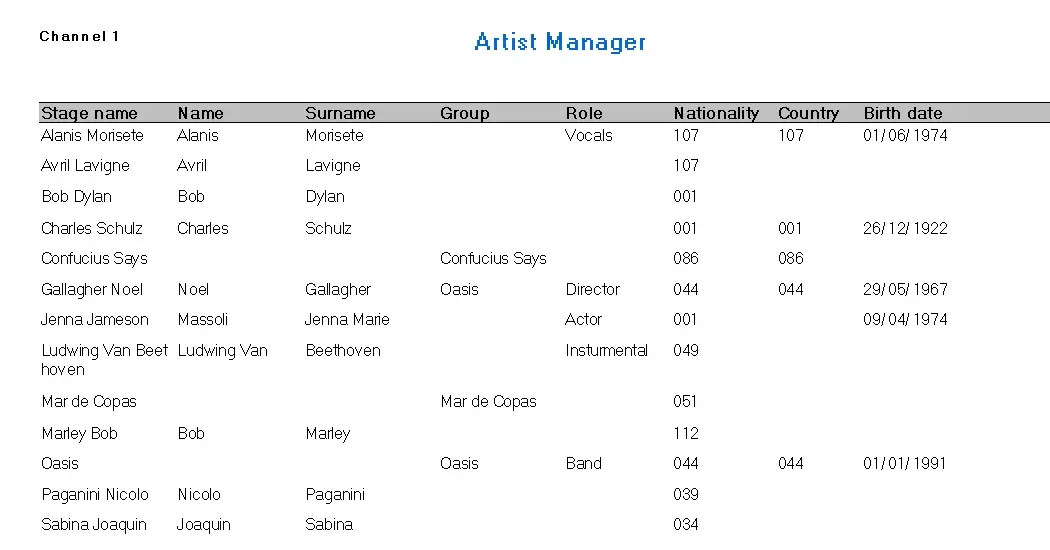
Brief Description: A list of all the artist inserted in the database, including their presence in your schedules
Report Description
A complete detailed list of all the artist inserted in the database, including their presence in your schedules.
Report Filters
All the parameters that permits a detailed generation of the report have been spread across seven different tabs to allows an easier configuration. By default all filters are disabled (i.e.: they are either blank or unselected), to enable them it is enough to configure at least one parameters on their inside. Available filters includes:
•Stage name
This area permits, as it name suggests, to narrow the retrieved results by specifying any of the following filters concerning the stage-name field:
- Starts with: Enter the string with which stage-name must begin in order to be retrieved in the report (e.g.: stage-name like 'test*'),
- Between: Insert two values, and only those assets which stage-name is comprehended between them will be retrieved (e.g.: stage-name between '500' and '600'),
- Contains: In order to be retrieved, assets' stage-name must contain the string inserted here (e.g.: stage-name like 'test'),
- It doesn't contain: In order to be retrieved, stage-names must NOT contain the string inserted here (e.g.: stage-name not-like 'test'),
- Empty: Only those events which stage-name is empty will be retrieved (e.g.: stage-name = '').
NB: From the last etere versions, along with the stage name is exported its multilanguage field too.
•Name
This area permits, as it name suggests, to narrow the retrieved results by specifying any of the following filters concerning the artist name field. Its filters works exactly as the stage-name ones.
•Surname
This area permits, as it name suggests, to narrow the retrieved results by specifying any of the following filters concerning the artist-name field. Its filters works exactly as the stage-name ones.
•Group
This area permits, as it name suggests, to narrow the retrieved results by specifying any of the following filters concerning the artist-group field. Its filters works exactly as the stage-name ones.
•Sort by
Specify here the field on base of which the printed content will be ordered. It is possible to choose to sort data by stage name, artist name, artist surname or artist group.
•Properties
This tab permits to customize the layout of the report by selecting the complementary-information that will be displayed on it. You can also decide to include some standard info, such as:
- Print date: Enable it to display the date (and time) in each page footer,
- Pages number: If active, a progressive number will be displayed in the footer on all pages across the report,
- Operator: It is the login name of the person who performs the report,
- Station name: The name of the station from which the report is being performed,
- Multiple lines text: Enable this option to continue printing a detail in another line instead of truncating it (as by default).
- Interline: Enable this option to increase the space between lines to 1.5 cm (one-and-one-half), by default -when disabled- this space is set to 1 cm (single).
- Columns: It permits to specify the database fields that will be included in the report. In the top part of the columns window will be displayed the column headers as they will be shown in the report, it is possible to arrange them just by using drag and drop.
The report may be based on Stage name, Name, Surname or Group, it can be based on any of the previously mentioned 'headings' and more specifically whether they start with a certain letter, those that contain a certain word and finally a selection of artists between x and y. For example generating a report of all the Artists held in the database whose name starts with 'ST' produced the following result:
Display Active Filters
In the middle of the form, a summarizing list will be displayed, containing all the filters enabled for the current report:
summarizing list
summarizing list
Report Preview
The [Settings] permits to configure the page layout of the outgoing document; once filters and settings have been set it will be possible to select between displaying a preview using the related [Preview] button or printing the document directly using the [Report] button. Please note that some reports permit to export the generated document in the most common formats (pdf, csv, doc, xls, xml, etc) just by using the [Export] button.
Artist Manager
 summarizing_list
 Artist_Manager