59.4.7 Copy action
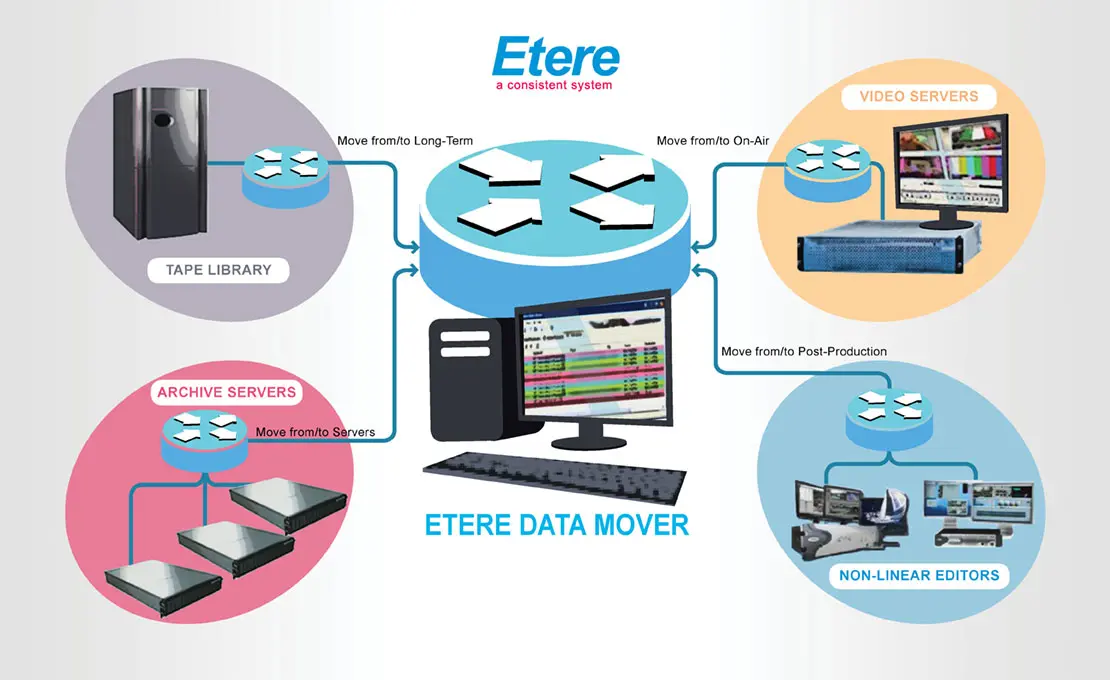
The Copy section located in the Configuration Editor module allows to define of Copy actions, a special kind of workflow actions used (as workflow action blocks) to transfer media files from one device to another:
Copy_action
To start managing Copy actions, select under the toolbar located in the upper part of the window tone the following options:
Create new action: Creates a new Copy action from an empty form.
Bind to: Alternatively to a new action creation, this function makes a table appear listing various Copy actions used by Etere versions previous to 19 (e.g. ftp_cache to ftp_onair, ftp_onair to low_res, etc.).
NB: Select the 'new action' option before using the 'bind to' option because it will overwrite the last opened action.
Duplicate action: Create a new action with the same parameters set on the currently open action.
Open existing action: List all the existing actions and allows you to open them.
Delete action: Removes the current open action completely.
NB: It is only possible to delete actions not currently used by a T-workflow. Otherwise, a warning message will inform about the issue indicating the related T-workflows.
Refresh: Update the list of actions located at the left of the window.
NB: You are advised to refresh the configured T-workflow and ensure the configured actions are loaded correctly before executing the T-workflow action.
NB: Do not run any Copy action parallel with Archive/Restore operation to avoid file non-existent error. Alternatively, pause the Archive/Restore service when the error occurs and retry the Copy action.
1. Main Information
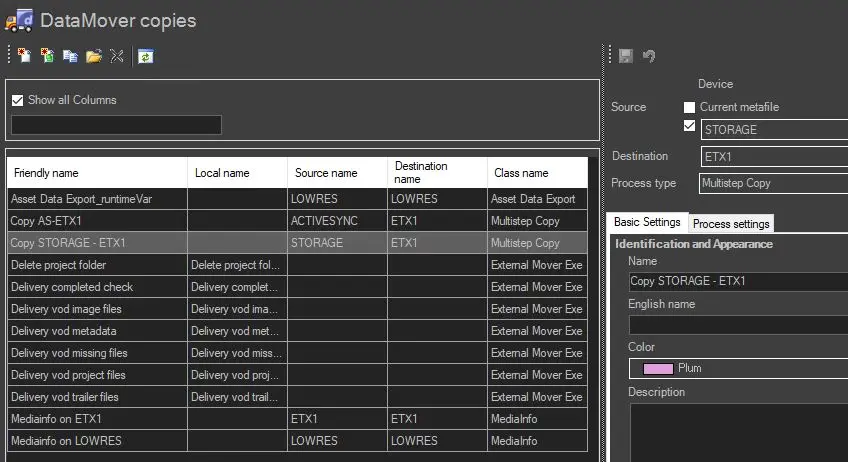
On the left is located the checkbox Show all columns; if ticked, beside the action name, the main properties of the action (i.e., local name, source, destination and class name) will be listed.
destination_device_and_process_type
Within the Copy section, at the right of it, the following options must be entered:
Source device & codec: Select the metadevice where metafiles to be processed are located. The dropdown list will contain all those metadevices set in the Resource Editor. Select the codec with which the metafile is stored in the source metadevice.
NB: If the source device and codec have been defined, the "Current metafile" option must be unchecked.
Destination: Specify the metadevice where the files will be placed once processed. The dropdown list will contain all those metadevices set in the Resource Editor. Select the codec with which the metafile will be stored in the destination metadevice.
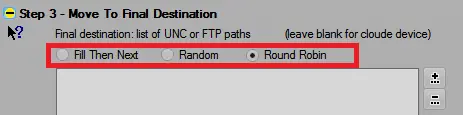
If Destination Paths have been explicitly configured, cloud path destination paths are ignored. Otherwise, if no path is configured, Data Mover loads the list of all associated paths with the selected cloud device and chooses the destination according to the specified policy.
NB: You can specify the destination path in UNC path format during the copy action.
Process type: Choose from the dropdown list the executable to be used for the current transcoding action:
External Mover Exe
Multistep Copy
VDCP Archive
VDCP Restore
MD5 Checksum
File Renaming
MassTech Mover
VACP Mover
Asset Data Export
MediaInfo
Packaging
SFTP
2. Basic Settings
Once you have compiled the fields above and have saved the action, two tabs will be enabled to enter relevant data regarding how the 'data movement' will be performed. The 'Basic Settings' tab holds the basic information about the current action, including:
Name: It usually starts with the "COPY" string to indicate a DataMover action related to the information handling (e.g. Copy VideoServer1 to Archive).
English name: If the previous name is given in a non-English language, insert its translated version here for the easiest multilingual recognition.
Color: Indicate the colour to display the action block in the T-Workflow Designer section.
Description: Insert a brief text explaining what the action is intended to do.
Concurrent processes: This parameter indicates the number of instances (by default, only one) of the current action that each Etere Data Mover server will be allowed to run contemporaneously.
NB: Etere suggests using concurrency, for example, if the current action will be used simultaneously by various T-workflows or if the source and destination count with a wide bandwidth.
Run each task using a separate agent process: Etere Data Mover will launch each instance of the current action in a separate Etere Data Mover agent, thus avoiding possible concurrency issues. Etere suggests allowing this parameter in case of high concurrency.
NB: Please note that detailed information on concurrency and agents is available in the Distributed concurrent processing section of the Etere Data Mover chapter.
Maximum Bandwidth: Indicate here the bandwidth limit in Mbit per second (0=disabled) to be applied to the current action; it will limit the bandwidth used by Etere Data Mover for performing this action (i.e. NTFS/NFS, transfer, FTP download, FTP upload, FTP move). If the bandwidth is set to "0" (unlimited), the bandwidth would be fully utilised by the current (single) process.
The maximum bandwidth is applied to a single process; therefore, in the case of multiple concurrent copies, the total bandwidth will be the sum of all active processes.
The maximum bandwidth is only supported for multistep copies; if the "use external ftpexec process" option is enabled, the bandwidth limitation will require the "Run each task using separate agent processes" option.
The Maximum Bandwidth is not valid for FTP Server to Server copy.
Do not use media folders even if configured: If disabled (by default), the file transfer will be performed by reading the source/destination paths from the selected metadevice's media folder (i.e. etereweb path); otherwise (if enabled), it will be performed reading the paths directly from the database (i.e. media folder for the asset forms).
NB: Please note that media folders are available only for DataMover actions that read data (i.e. files/paths) from the database (e.g. multistep copy, transcoding, etc.).
Destination metafile: Specify the method to be used for naming the metafile stored in the final destination; available methods include:
Keep source name - The metafile (file_id) will maintain the source filename.
Use asset ID as a name - The metafile (file_id) will be renamed using the asset's ID.
Use asset Code as a name - The metafile (file_id) will be renamed using the asset's Code.
Use asset Code + Type as a name - The metafile (file_id) will be renamed, concatenating the asset's code and type (e.g., COM, NEWS, PROMO, etc.).
Generate a unique name - Enable this option to generate a transcoded file named using a unique name (UID).
Use rule - Rename the destination metafile according to one or more Flexi-metadata; the button will allow you to define a custom name through the editor as explained in the Multistep Copy and File Renaming chapters. NB: The value of this field is displayed as read-only, being it possible to copy it.
DB Update: These options allow to specify how to update copied files in the database. Available options include:
Update DB files if the job finishes successfully - The file will be updated in the database once the job completes successfully.
Update DB files immediately after the job starts - The file will be updated in the database immediately after the job starts,
Never update DB files - The file won't be updated in the database.
Update all assets linked to the source file - If enabled (default), the copied file will be associated with all the asset forms linked to the source file. Enabling this option is useful; for instance, when a single file is used by multiple assets (e.g. which transmit it overlaid with different logos); in this case, every time the file is copied, the new copy will be updated across all linked assets.
If disabled, the copied file will be associated only with the asset form for which the T-workflow has been launched. Disabling this option is useful, for instance, when a single big file (e.g. a live feed recording) is used by multiple assets which partially retrieve a smaller file from it; in this case, only the asset from which the partial retrieve has been executed will be updated.
3. Process Settings
The 'Process Settings' tab display and allows to modify the various steps performed by the system to perform the action in question. Since parameters present in this section depend on the selected Process Type, the following chapters will explain how to configure each.
 Copy_action
 destination_device_and_process_type
 move_to_final_destination